


There’s a moment in childhood when the world feels impossibly large — when wandering off the path isn’t recklessness but discovery, and the dark holds as much wonder as fear.
“Balam” understands that feeling intimately. Director Guillermo Casarín’s animated short follows Itzel, a young girl of Mayan descent, on a camping trip with her father deep in the jungle. What begins as a quiet night of stargazing becomes something far more extraordinary when curiosity pulls her into the wilderness — and into a collision with her ancestral past.
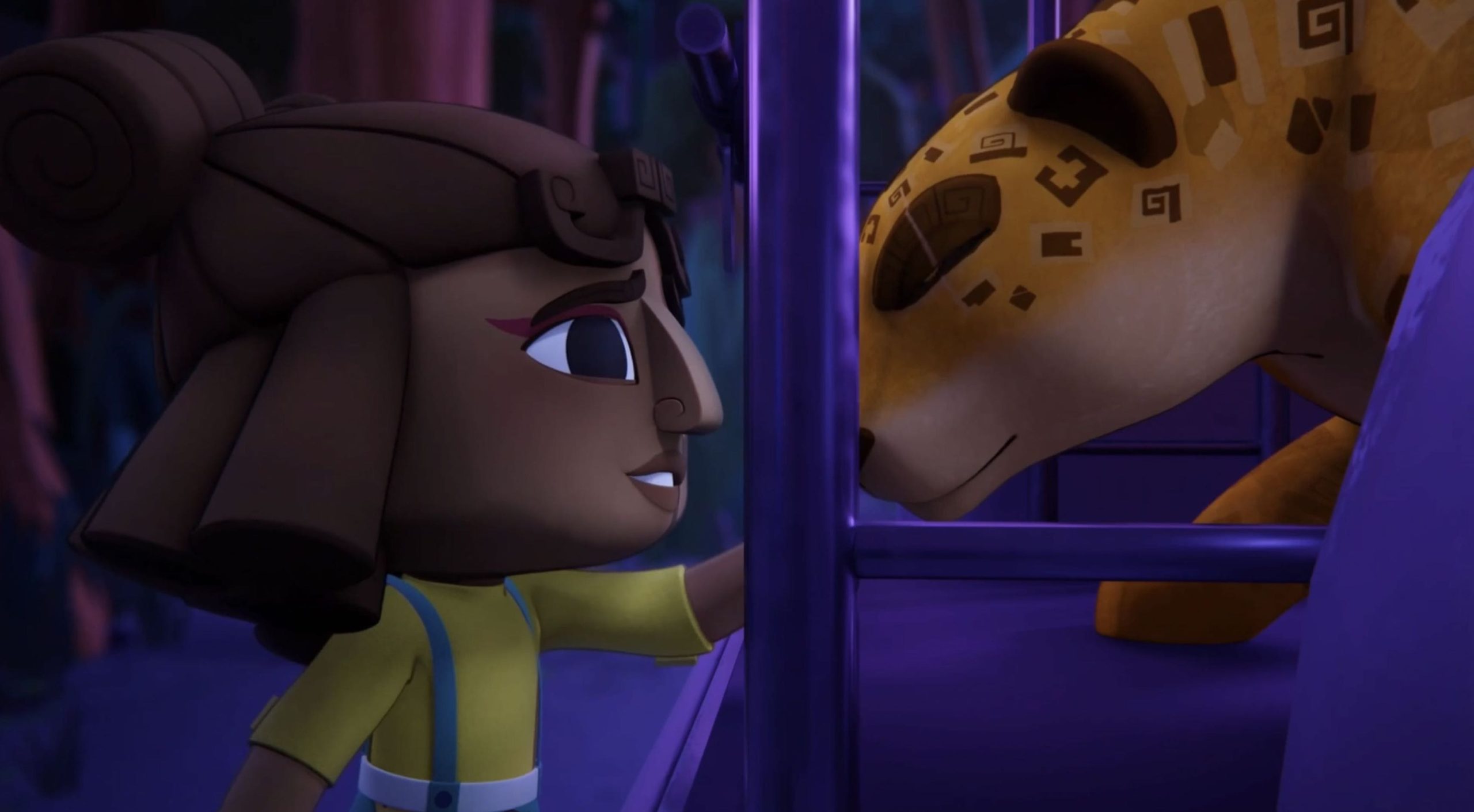
Separated from her father and searching for a phone signal (a perfectly modern detail that grounds her before the mystical turn), Itzel stumbles upon a caged jaguar on a poacher’s truck. Without hesitation, she frees it. Casarín doesn’t linger on the decision. For Itzel, there’s no calculation — only instinct. The jaguar shouldn’t be caged. So she opens the door.
What follows is a journey into mystery. Fleeing deeper into the jungle, Itzel discovers a hidden Mayan city — stone walls glowing with ancient puzzles, temples awakening as if they’ve been waiting for her. The jaguar she freed reveals itself as Balam, a spirit guide who leads her through visions of the city in its glory days. Serpent constellations spiral across the night sky. The stars become a map. What felt like being lost becomes a different kind of finding.
Casarín tells this story without a single word of dialogue, and the silence is essential. “Balam” operates on pure visual storytelling — the rustle of jungle foliage, the glow of sacred geometry, the weight of a child’s footsteps in an ancient place. The animation balances warmth and grandeur, rendering Itzel small against the temple walls but never insignificant. Her scale emphasizes courage rather than vulnerability.
A poacher lurks at the edges of the story, a reminder that wonder and threat often share the same territory. But “Balam” isn’t ultimately about danger — it’s about inheritance. The lost city isn’t a backdrop for adventure; it’s a birthright Itzel is only beginning to understand. The film treats Mayan mythology and astronomical knowledge with evident respect, weaving educational context into its final moments without breaking the spell. This is heritage as living thing, not museum artifact.
Produced through USC with support from the Alfred P. Sloan Foundation, “Balam” carries the polish of a studio production with the heart of something personal. At roughly ten minutes, it doesn’t waste a frame. The journey from campfire to constellation feels both epic and intimate — a girl finding her way home by learning to read the stars her ancestors mapped centuries ago.
Some films teach you something. Others make you feel it. “Balam” does both.tory, not the tragedy, not the triumphant romance — just two men who might not be good for each other, trying to figure out if they’re willing to keep trying. The cultural pressures are present but unspoken: the visa, the public affection Thiago craves and Jake withholds, the sense that their relationship exists without a script.
At around five minutes, the film trusts its performances, trusts its silences, and trusts you to sit with ambiguity. That’s harder than it sounds.