

Maribel is drifting. In the wake of her mother’s death, she finds herself anchored to a reality she isn’t quite ready to inhabit. But rather than retreating into the traditional shadows of isolation, she seeks a different kind of solace. S/W newcomer Merced Elizondo’s The Mourning Of is a profoundly sobering exploration of the architecture of loss—and the lengths we go to avoid building our own.
The premise is as haunting as it is human: Maribel (Natalia Villegas) has become a professional mourner of sorts, albeit an uninvited one. She spends her days scouring the obituaries, circling names in red ink, and attending the funerals of strangers. It is a quiet, desperate ritual—a way to “borrow” the grief of others to avoid the suffocating weight of her own. Elizondo crafts this narrative with a delicate touch, recognizing that avoidance is often just a survival mechanism in disguise.
“Grief cannot be borrowed, postponed, or escaped—only carried,” the film suggests, and that truth sits at the core of Maribel’s unraveling. As she sits in pews listening to eulogies for people she never knew, the film taps into something deeply universal: the paradox of feeling most connected to the world when we are witnessing its ending.
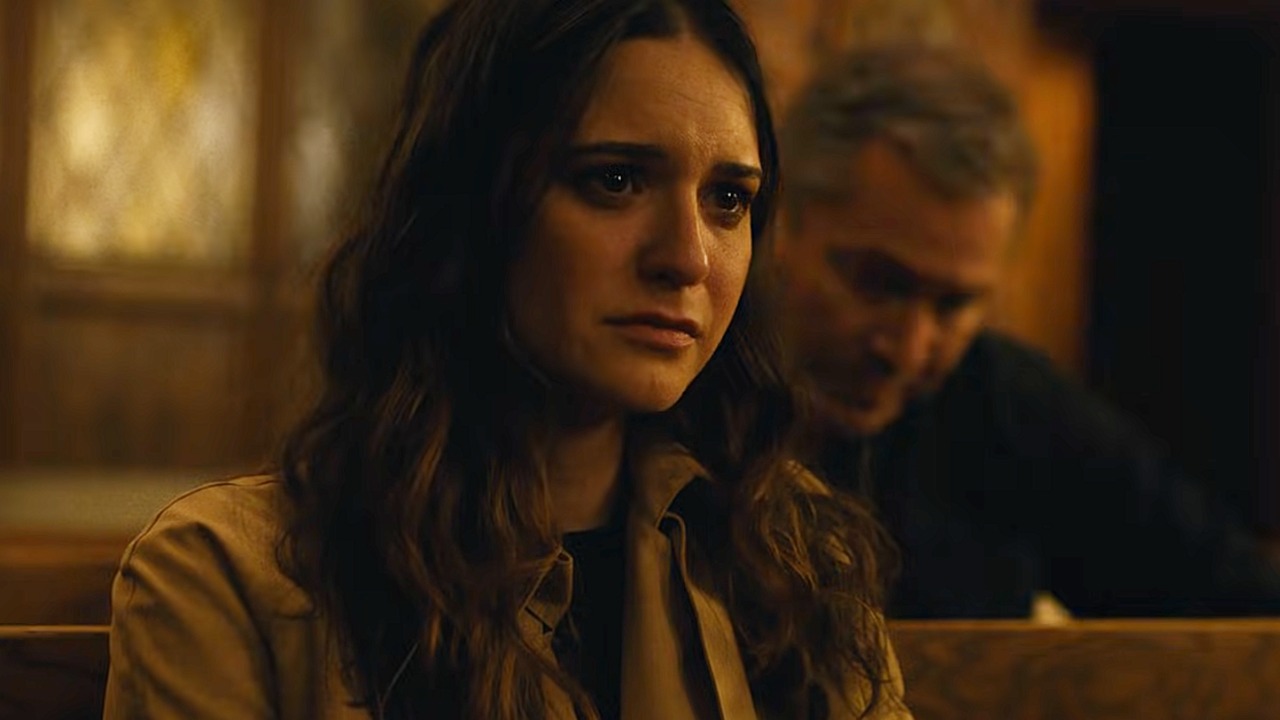
The performances here are the film’s heartbeat. Natalia Villegas delivers a remarkably internal performance; her Maribel is a woman vibrating with a stillness that suggests she might shatter if anyone looks too closely. Opposite her, the veteran Julio César Cedillo (known for Sicario and The Three Burials of Melquiades Estrada) brings a grounded, watchful presence as Father Tomas. Their interaction in the confessional/pew setting provides the film’s “gut-punch” moment—a confrontation that forces Maribel to stop hiding in the shadows of other people’s tragedies.
Visually, DP Matheus Bastos immerses us in a world of rich, ecclesiastical textures. The lighting is warm yet heavy, capturing the dust motes dancing in the sunlight of old churches and the stark, lonely interior of Maribel’s car. There is a specific visual language at play here—one that contrasts the communal, public celebration of life (the white balloons ascending into a Texas sky) with the private, messy reality of Maribel’s internal collapse. Editor Jonathan Cuartas (director of S/W pick My Heart Can’t Beat Unless You Tell It To) finds a pacing that mimics the stages of mourning: slow, rhythmic, and then suddenly, devastatingly fast.
What makes The Mourning Of resonate is its refusal to offer easy catharsis. It understands that moving forward isn’t a linear path, but a series of small, painful choices to finally speak the name of the person you’ve lost. The final image of the film doesn’t promise that the pain is over, but it suggests that Maribel is finally ready to stop being a spectator in her own life.
Having recently completed its run on the festival circuit with stops at notable venues like the Dallas International Film Festival and HollyShorts, Elizondo’s film marks him as a talent to watch. He is currently developing new work that continues his interest in narratives “steeped in sincerity,” and if The Mourning Of is any indication, we can expect many more tears—and triumphs—in his future.